
How to jump start an automatic car
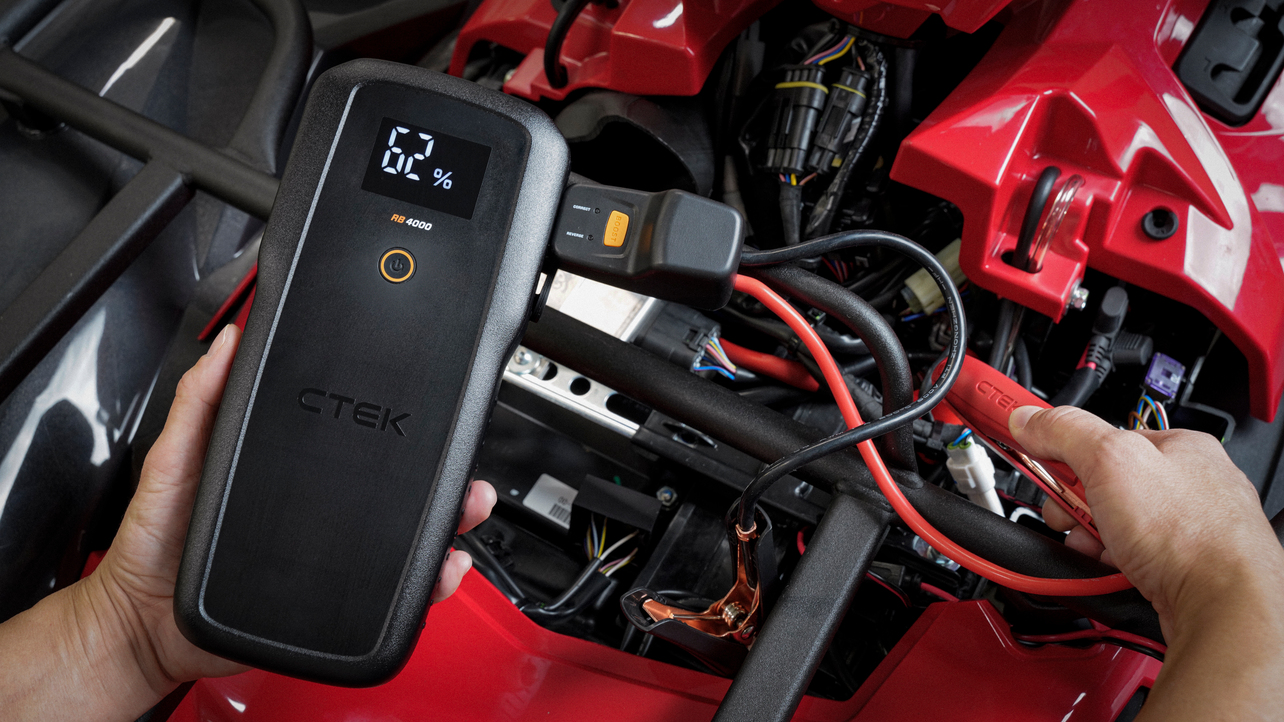
If you drive an automatic and find yourself with a flat battery, knowing how to jump start it is very useful knowledge. Unlike manual vehicles, automatic cars can’t be push-started, so you’ll need to use either jump cables with a second vehicle or, preferably, a portable booster pack such as CTEK’s RB 3000 or RB 4000.
Here’s a guide to help you understand how to jump start an automatic car (or indeed a manual car) to get it safely back on the road.
Step-by-step: how to jump start an automatic car
- Safety first: ensure both vehicles (or your car and the booster) are on a flat surface, with engine(s) off and handbrake(s) engaged. Remove any metal jewellery and keep flammable materials away from the battery.
- Locate the battery: open the bonnet and identify the battery terminals – positive (+) is usually red and negative (–) is black.
- Using a booster pack: for a safe and convenient method, use a booster such as the RB 3000 or RB 4000. Connect the red clamp to the positive terminal and the black clamp to an unpainted metal surface on your car (not directly on the battery). These boosters are designed to deliver the necessary power safely and are far more portable and reliable than relying on another vehicle.
- Using jump cables: if you’re using jump cables and a second vehicle, connect the red cable to the positive terminal of the flat battery, then to the positive terminal of the charged battery. Attach the black cable to the negative terminal of the charged battery, and the other end to a suitable earth point on the car.
- Start the engine: With everything connected, switch on the booster (or start the engine of the support vehicle), then attempt to start your car. Once it’s running, carefully remove the cables or booster clamps in the reverse order.
- Let it run: allow your car to run for at least 20 minutes to give the battery a chance to recharge. If the car doesn’t start, check all connections and try again, but don’t crank the engine for more than a few seconds at a time.
Why use a booster instead of jumper cables?
While traditional jump cables can do the job in a pinch, they rely on another vehicle and can pose safety risks if not used properly. Booster packs such as the RB 3000 and RB 4000 provide a safer, quicker alternative. They’re compact, easy to store in your boot, and eliminate the need to flag down a stranger or wait for roadside assistance. The RB 3000 is perfect for most standard vehicles, while the RB 4000 offers even more power for larger cars or frequent use.
The CTEK boosters also do more than just boost. With USB-A and USB-C ports, they double up as high-capacity power banks for your electronic devices. Plus, a built-in LED flashlight with emergency modes can help if you are stuck with a flat battery in the dark. They also have built-in spark-proof technology and reverse polarity protection, offering more safety advantages over using cables to a second vehicle.
Final tips
- Always follow the manufacturer’s instructions for your car and any equipment you use.
- If your car doesn’t start after several attempts, seek professional help – there may be a deeper issue at play.
- Regularly check your battery’s health, especially before long journeys or in cold weather. Use a CTEK battery charger to optimise your battery’s condition.
By following these steps on how to jump start an automatic car, you’ll be prepared. And with a reliable booster like the RB 3000 or RB 4000, you’ll be back on the road in no time.