
Jump starter vs battery charger
They are both designed to help your vehicle battery, but which one is the right tool for which scenarios?
When thinking about caring for the battery in your car, motorcycle, motorhome or other vehicle, you may be wondering whether you need a battery charger, a jump starter – or both.
A jump starter (also known as a battery booster) and a battery charger sound like they may do the same sort of task, but actually they do very different things. Let us consider them in turn.
Battery charger
The 12V battery in your vehicle is primarily used to start the engine but it also powers a modern vehicle’s substantial electrical systems. If the battery is not adequately charged, it can fail to start the vehicle.
A battery charger, used regularly, will ensure your battery is always ready to go. It will have enough power to turn the engine over enough times for it to start.
Having a battery charger at home – and remembering to connect it to your vehicle frequently – is a sure way to give your battery and your vehicle the best chance of worry-free starting and motoring.
Using a smart battery charger – such as CTEK’s NXT 5 – gives you access to smarter charging, advanced charging modes, automatic spark-free operation, reverse polarity protection and connect-and-forget functionality.
A battery charger, regularly used, provides preventative peace of mind to minimise the chances of a breakdown or not being able to start at all.
Regular charging can prolong a battery’s life by up to three times. And it is better for your battery’s health to top up with a battery charger than to use a jump starter. But sometimes you may need to quickly tackle a low battery, which is where a jump starter comes in handy...
Jump starter
Sometimes batteries get drained. Frequent short trips, extreme temperatures and using power without the car being run can all deplete the charge held by the battery . And if that happens, the car may not be able to turn the engine. It’s a problem when you are at home hoping to go for a drive but a much bigger problem if you are stranded somewhere out and about.
If you are at home – and you have a battery charger – you have a solution. But if you are not at home then this is when a jump starter, also known as a booster, can come in very handy.
Where a battery charger is a proactive tool for vehicle maintenance, a jump starter is a reactive device for unforeseen or emergency situations.
Think of a jump starter as a portable power bank which can provide the necessary charge to give your battery and vehicle enough power to start and keep going.
Pack a charged jump starter in the boot of your vehicle and you’ll always have that boost to hand should your run into battery problems.
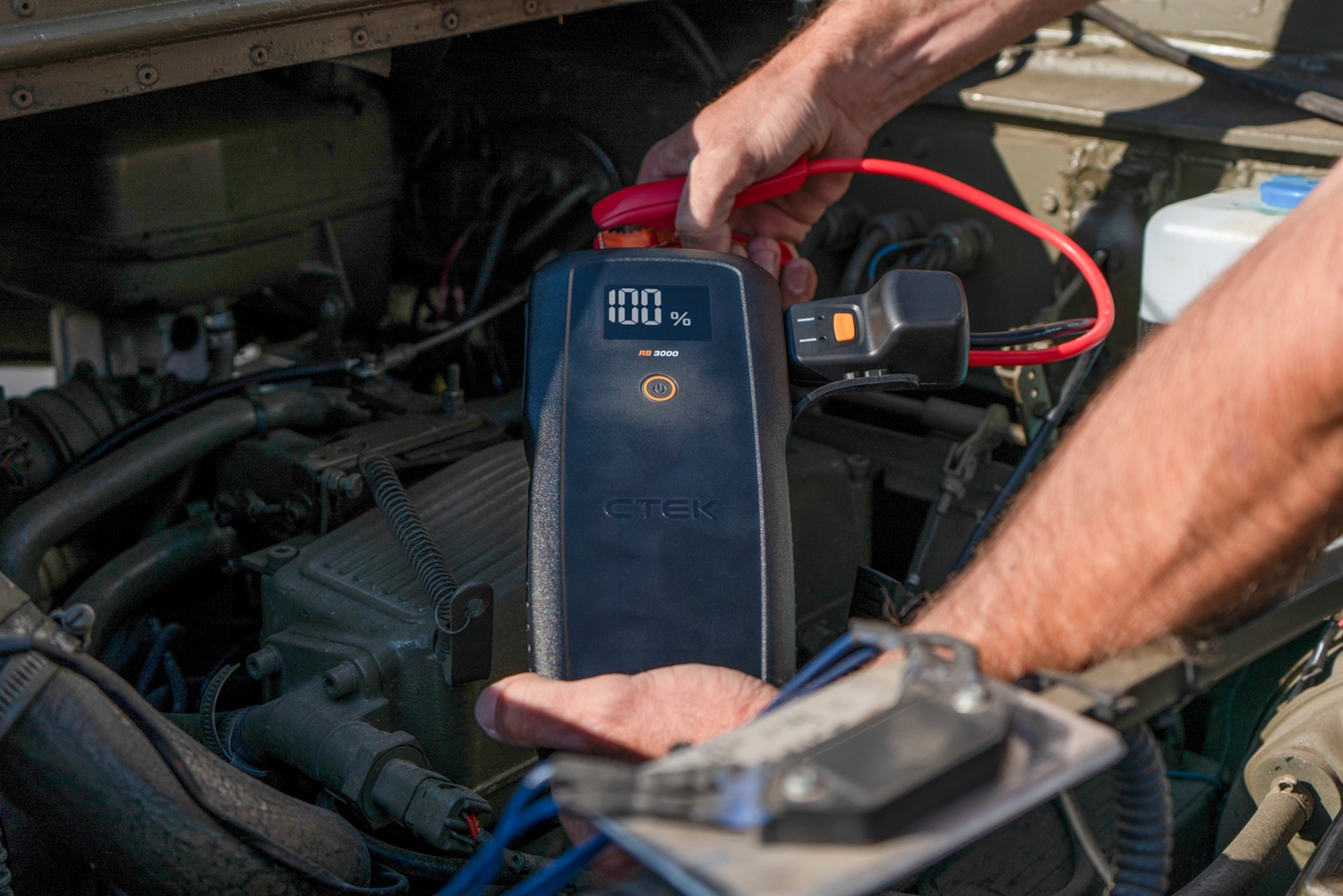
A jump starter such as CTEK’s RB 3000 not only has enough power for up to 30 starts, it also has doubles up as high-capacity power bank for your electronic devices and has a built-in LED flashlight with emergency modes for if you are stranded at the roadside.
The RB 3000 is fully charged and ready for action after just 2.5 hours plugged in at home. It is light enough and compact enough to fit in any vehicle and very easy to use.
The verdict
Our key recommendation is to use a battery charger regularly at home to maintain your battery at its optimum charge. But having a charged-up booster on your travels makes sense too, for if and when you need a jump start.
So when it comes to jump starter vs battery charger, it’s no contest. Both are good to have for a win-win result.